Symposium Obdobja 45
SLOVENE IN THE ERA OF SMART TECHNOLOGY
Submitting a contribution
Important dates
| Description | Date |
|---|---|
| Submitting a contribution (up to 20,000 characters with spaces) | 5 May 2026 |
| Notification of the referees’ evaluation | 1 July 2026 |
| Submission of the final (revised) version of the paper | 20 July 2026 |
| Notification of inclusion of the paper in the programme | 25 September 2026 |
| Payment and registration fee | 10 November 2026 |
| Symposium | 18–20 November 2026 |
General Information
-
Invitation
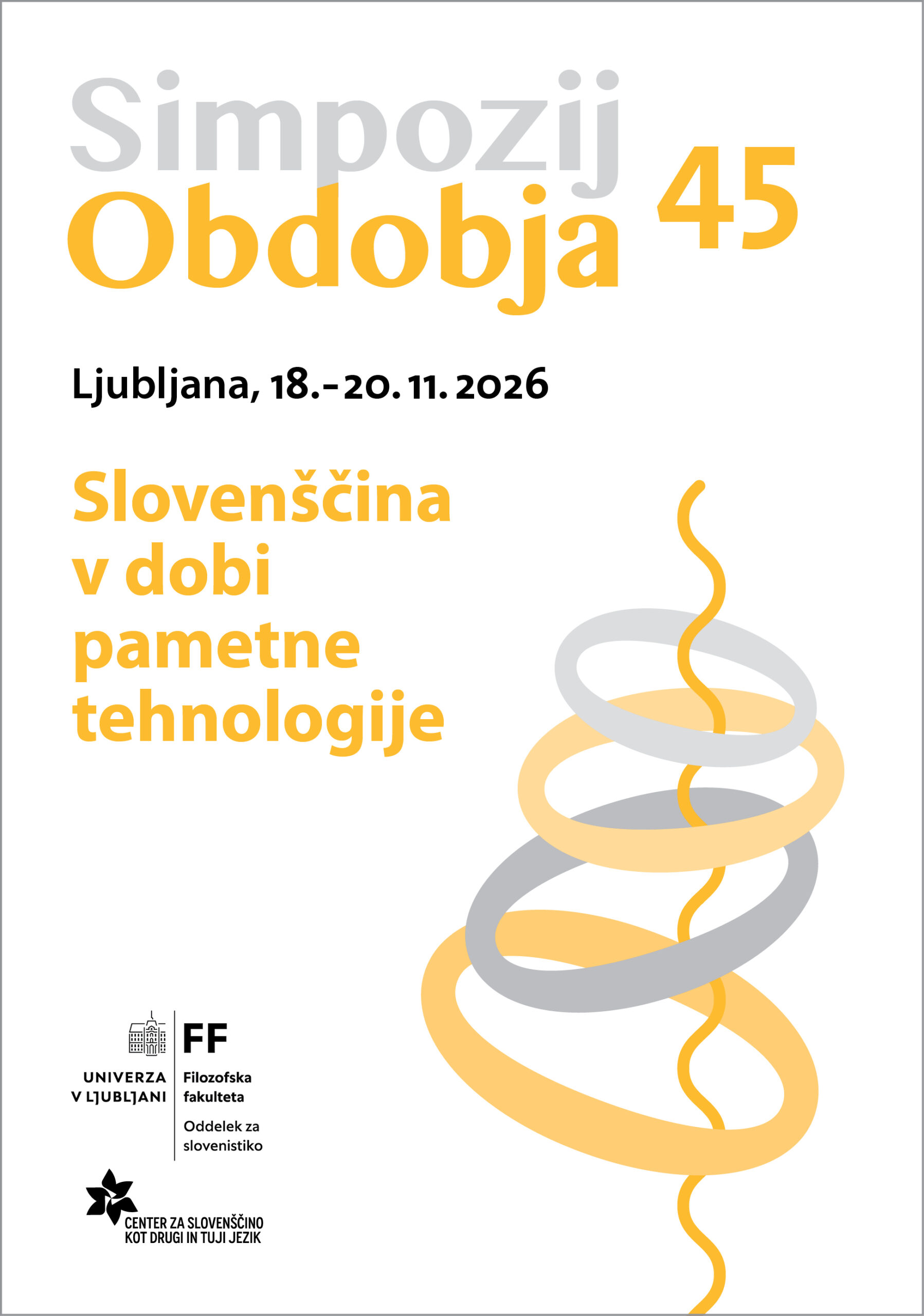
You are invited to take part in the 45th international Obdobja Symposium, titled Slovene in the Era of Smart Technology, which will take place from 18 to 20 November 2026. It will be hosted by the Center for Slovene as a Second and Foreign Language at the Department of Slovene Studies, Faculty of Arts, University of Ljubljana.
Life in the third millennium is shaped by smart devices, social media, the constant flow of information, and global connectivity. Everything we need is just a click or a screen tap away. Multinational corporations, online stores, streaming services, large language models, machine translation tools, and smart homes make our everyday lives easier, while at the same time transforming our language and lifestyle habits.
Obdobja 45 will explore what today’s social and technological circumstances mean for Slovene and its speakers. The digital reality we live in influences, among other things, changes in vocabulary. To name previously nonexistent concepts and phenomena, we either borrow words from other languages or form them using native linguistic devices. The symposium will also examine whether technological development indirectly affects other levels of Slovene, from phonology and morphology to syntax and entire texts, both written and spoken, including those produced with artificial intelligence and other digital tools.
Another important set of issues related to this new era focuses on language users. How do Slovene speakers use the language under the current circumstances? Which language technologies do they use, and how—if at all—does language policy respond to this? There will also be room for discussions on the role of companies, corporations, and the global market—for instance, the efforts made to ensure the presence of Slovene in various software, on the internet, and so on.
The aim is to also examine the views of various social groups, such as young people, the elderly, and immigrants, on Slovene and other languages, especially English, the most widespread global language. What do they think about them, and how do they assess the advantages and disadvantages of this new era?
Finally, the symposium will also dedicate attention to language resources and technologies themselves. Among other things, it will explore how artificial intelligence and smart technologies can be applied in research on Slovene.
The goal of Obdobja 45 is to open an interdisciplinary discussion on the current state and development of Slovene in the Slovene-speaking environment, and to engage both the Slovene and international professional community in this discussion.
Asst. Prof. Dr. Mojca Stritar Kučuk, president of the 45th Obdobja Symposium
-
Thematic Areas
The basis for all the thematic sections proposed is Slovene and the Slovene linguistic landscape, which can also be addressed contrastively in relation to other language(s).- Language change
- The impact of the digital environment on vocabulary (loanwords, new vocabulary, semantic shifts, word formation and lexicon, and terminology)
- Changes in grammar (phonology, morphology, and syntax) in digital communication and beyond
- Description and analysis of language within individual genres (e.g., literary, academic, and media texts)
- Language use and attitudes
- The role of Slovene in the media and online
- Language use across generations (young people, the elderly)
- Language use among immigrants and speakers of Slovene as a non-native language
- Attitudes toward English and other global languages
- The relationship between the use of Slovene and English in contemporary communication by various generations, interest groups, professional groups, and so on
- Language and technology
- Development and use of language technologies and resources for Slovene (large language models, machine translation, speech recognition, and speech synthesis)
- Application of artificial intelligence methods and smart technologies in linguistic and literary research
- Language and cultural heritage in the digital age (digitization of texts, archives)
- Ethics and social responsibility in developing language technologies
- Language policy and planning
- Slovene in software, online services, and smart devices
- Language consulting services
- Strategies for preserving and promoting the use of Slovene in the digital environment
- Legal and ethical issues related to digital language infrastructure
- Institutional and corporate responses to the language situation
- Language education
- Teaching Slovene as a first, second, and foreign language
- Language apps, tools, and games
- Digital literacy of teachers and learners
- Changes in assessing and evaluating language proficiency and language norms
- Language change
-
Organisers
The Symposium is organised by The Centre for Slovene as a Second and Foreign Language at the Department of Slovene Studies, Faculty of Arts, University of Ljubljana, Trubarjeva cesta 3, 1000 Ljubljana, Slovenia.
Symposium president
Asst. Prof. Dr. Mojca Stritar Kučuk, University of Ljubljana, Faculty of Arts
E: [email protected]Symposium organisers
Asst. Prof. Dr. Damjan Huber, University of Ljubljana, Faculty of Arts
Teja Rebernik, University of Ljubljana, Faculty of Arts
E: [email protected]
T: 00386 1 241 86 76Technical editors of symposium publications
Matej Klemen, University of Ljubljana, Faculty of Arts
Mag. Mateja Lutar, University of Ljubljana, Faculty of Arts -
Programme committee
- Res. Assoc. Dr. Špela Arhar Holdt, University of Ljubljana, Faculty of Arts; Faculty of Computer and Information Science
- Dr. Mateja Eniko, University of Ljubljana, Faculty of Arts
- Res. Assoc. Dr. Apolonija Gantar, University of Ljubljana, Faculty of Arts
- Asst. Prof. Dr. Lara Godec Soršak, University of Ljubljana, Faculty of Education
- Lect. Dr. Nataša Hribar, University of Klagenfurt, Faculty of Humanities & Education, Austria
- Asst. Prof. Dr. Mateja Jemec Tomazin, Research Center of the Slovenian Academy of Sciences and Arts, Fran Ramovš Institute of the Slovenian Language
- Sr. Res. Assoc. Dr. Iztok Kosem, University of Ljubljana, Faculty of Arts; Faculty of Computer and Information Science
- Asst. Prof. Dr. Tina Lengar Verovnik, University of Ljubljana, Faculty of Social Sciences; Research Center of the Slovenian Academy of Sciences and Arts, Fran Ramovš Institute of the Slovenian Language
- Res. Assoc. Dr. Andrej Perdih, Research Center of the Slovenian Academy of Sciences and Arts, Fran Ramovš Institute of the Slovenian Language
- Asst. Prof. Dr. Eva Pori, University of Ljubljana, Faculty of Arts
- Asst. Prof. Dr. Tadeja Rozman, University of Ljubljana, Faculty of Public Administration
- Prof. Dr. Mojca Smolej, University of Ljubljana, Faculty of Arts
- Prof. Dr. Marko Stabej, University of Ljubljana, Faculty of Arts
- Asst. Prof. Dr. Mojca Stritar Kučuk, University of Ljubljana, Faculty of Arts
- Asst. Prof. Dr. Jana Volk, University of Primorska, Faculty of Humanities
- Prof. Dr. Rok Žaucer, University of Nova Gorica, School of Humanities
-
Venue
University of Ljubljana (main building, 1st floor), Kongresni trg 12, Ljubljana, Slovenia. -
Registering for the symposium and submitting a contribution
Registration will take place until 25 January 2026 via the symposium website (Symposium Obdobja 45, Registration Form). Upon registration, a summary needs to be submitted of around 250 words, including proposed references. By 10 February 2026 applicants will receive notice of acceptance.
When selecting contributions, we will take into account the theme and its relevance to the section chosen, as well as clarity, comprehensiveness, variety and innovativity.
The deadline for submission of papers is 5 May 2026 (up to 20,000 characters with spaces, including literature and notes). Guidelines for formatting the text will be sent to authors via email and will also be published on the symposium website.
Before printing, contributions will be subject to blind review by two peer reviewers, and authors will be notified of the reviewers’ evaluation by 1 July 2026 at the latest.
The final (corrected) version of the paper will need to be submitted by 20 July 2026; notification of inclusion in the symposium programme will be sent to participants by 25 September 2026.
Papers will be published in a thematically rounded monograph which participants will receive at the event and which will also be freely available on the website of the Centre for Slovene in the section Obdobja publications.
-
Registration fee
The fee for taking part and presenting a paper is 100 EUR and includes a folder containing symposium material, the publication of the paper, the symposium proceedings, the accompanying programme, lunches and event organisation. Participants will be sent an invoice via e-mail. 10 November 2026 is the deadline for the payment of the registration fee. -
Presentation of a paper
The time available for the presentation is 15–20 minutes. Working languages will be Slovene and English; by prior agreement with the organisers the use of another language is possible. -
Accommodation in Ljubljana
Participants must book and cover the cost of accommodation themselves. Addresses of Ljubljana hotels are provided below.
Hotel Emonec***
Wolfova 12, Ljubljana
T: 00386 51 399 814, 00386 1 200 15 20
E: [email protected]
W: https://www.hotel-emonec.com/sl/
Distance from the University: 5 minHotel Mrak***
Rimska cesta 4, Ljubljana
T: 00386 1 421 96 50
E: [email protected]
W: https://hotelmrak.si
Distance from the University: 5 minCity Hotel Ljubljana***
Dalmatinova 15, Ljubljana
T: 00386 1 239 00 00
E: [email protected]
W: https://www.cityhotel.si
Distance from the University: 15 minHotel Park***
Tabor 9, Ljubljana
T: 00386 1 300 25 00
E: [email protected]
W: https://www.hotel-bb.com/sl/hotel/ljubljana-park
Distance from the University: 20 minHotel Slon****
Slovenska 34, Ljubljana
T: 00386 1 470 11 00
E: [email protected]
W: https://www.hotelslon.com/sl
Distance from the University: 5 min