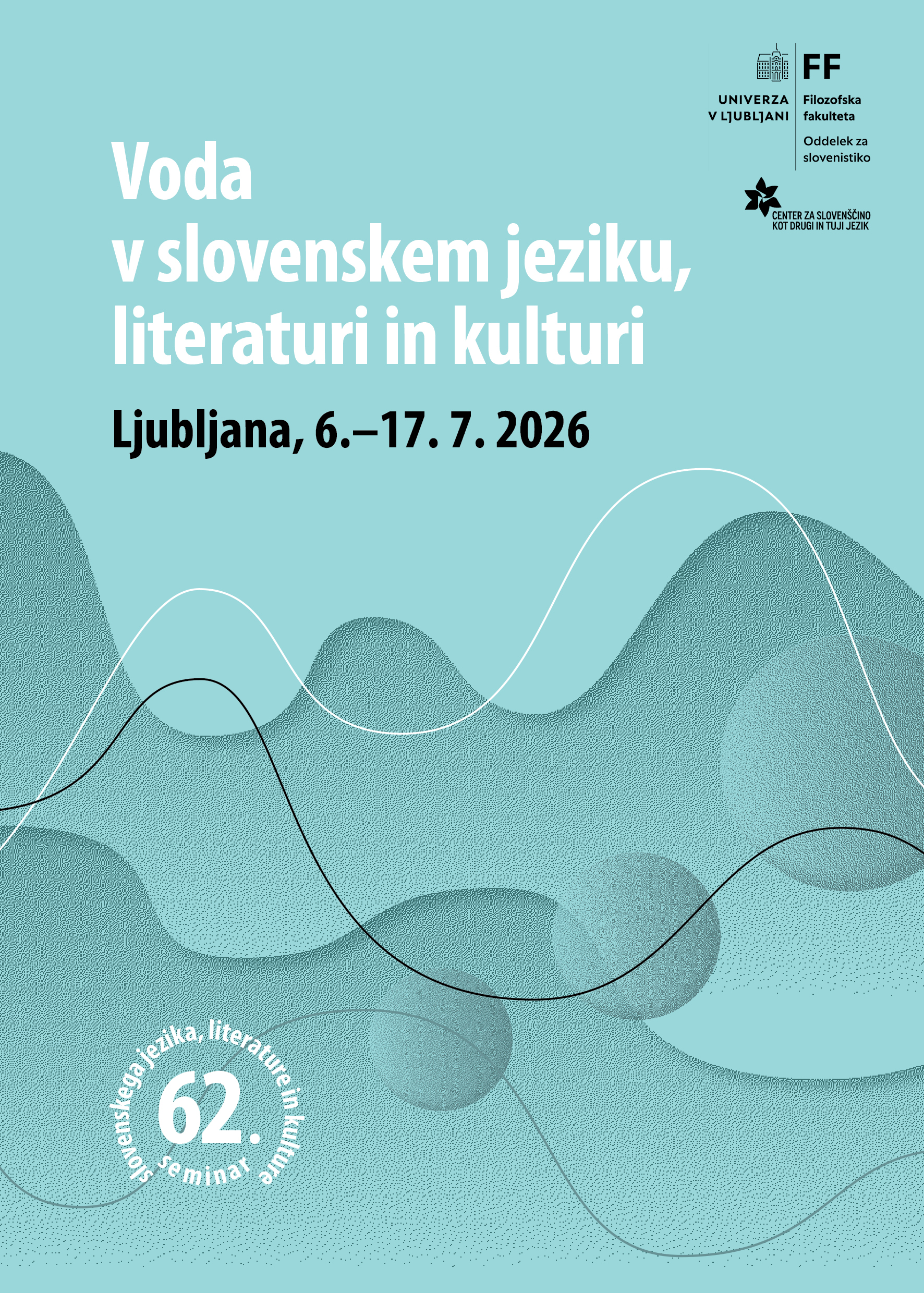
62nd Seminar of Slovene Language, Literature and Culture
WATER IN SLOVENE LANGUAGE, LITERATURE AND CULTURE
Registration Form
Important dates
| Description | Date |
|---|---|
| Submission of registration forms and language tests for scholarship recipients | 1 April 2026 |
| Registration by those paying for themselves | 1 May 2026 |
| Oral testing (Zoom) | May–June 2026 |
| Notification before departure for the seminar | 20 June 2026 |
| Payment by those paying for themselves | 30 June 2026 |
| Arrival at the seminar | 5 July 2026 |
| 62nd SSJLK | 6–17 July 2026 |
| Departure from the seminar | 18 July 2026 |
General Information
-
Invitation
Water, especially the sea, lakes, and rivers, plays an important and multifaceted role in language (particularly literature), culture, philosophy, various beliefs, mythologies, and more.
First and foremost, we think of its powerful symbolic value. Water is regarded as both a symbol and a source of life (e.g., in the Bible, where it carries numerous and often ambivalent meanings) and creativity, as well as survival—if one simply recalls the ancient civilizations that settled along great rivers. In mythological stories and religious texts, water can signify creation or divinity, as well as strength, wisdom, or truth; it can be a gift of God for survival. Water or the bodies of water mentioned above are often associated with purification, either physical or spiritual. In various religions (Christianity, Judaism, Hinduism, and Islam), water is used in rituals (e.g., baptism, immersion in the Ganges). Because of its fluid state and adaptability, water also embodies change. It is described as the most perfect companion on a journey because in flowing it also becomes a path itself. Water is a prominent motif and theme in literary works, where it serves as a vivid metaphor. Especially seas or lakes can symbolize the depths of human emotions, states of mind, and moods (from despair and melancholy to serenity and hope). They may also represent great, unfathomable, and dark mysteries. In literature, water can be a setting, it can illustrate the passage of time or life itself, it can serve as a backdrop for the story, or it can even help shape the character of literary figures. Throughout history, the beauty and magnificence of seas, lakes, and rivers have inspired writers and other artists, whose works continue to evoke powerful emotions. The fact that water is a vital element in the human experience, interpretation, and exploration of the world is confirmed by idioms, proverbs, and sayings (referring to water, the sea, lakes, rivers), as well as by the Slovenian folk tradition, which shows that water—home to a variety of mythical beings—has stirred human imagination throughout history.
The importance of water for Slovenia, which ranks among the richest European countries in natural water resources, is further affirmed by Article 70a of the Slovenian Constitution, which guarantees everyone the right to drinking water, and by the Slovenian coat of arms, which features two undulating blue lines representing the sea and rivers.
Prof. Ddr. Urška Perenič,
President of the 62nd SSJLK -
Organisers
The seminar is organised by the Centre for Slovene as a Second and Foreign Language at the Department of Slovene Studies, Faculty of Arts, University of Ljubljana, Trubarjeva cesta 3, 1000 Ljubljana, Slovenia. The morning programme takes place entirely at the Faculty of Arts, the University of Ljubljana, Aškerčeva 2, Ljubljana, while the afternoon and evening programme is organised at different locations in Ljubljana.
Seminar president: Ddr. Urška Perenič
Head of the language teachers: Dr. Damjan Huber
Seminar organisers: Dr. Damjan Huber, Teja Rebernik
Programme committee: Dr. Lidija Arizankovska, Dr. Zvonko Kovač, Dr. Mojca Nidorfer, Ddr. Urška Perenič, Dr. Jerca Vogel
Technical editor of seminar publications: Mag. Mateja Lutar
Student assistance: Jaka Ajlec, Neža Cerinšek, Anika Logar, Zala Mele, Anja Pirc, Nika Predalič, Domen Rob, Lea Stezinar, Tea Stezinar -
Lecturers and language teachers
The lecturers and language teachers leading the seminar are proven experts from the University of Ljubljana Faculty of Arts and outside collaborators.Lecturers: Dr. Maja Bjelica, Ddr. Igor Grdina, Dr. Nataša Jakop, Dr. Mira Kobold, Dr. Edvard Kovač, Dr. Matej Meterc, Ddr. Urša Perenič, Dr. Vera Smole, Ddr. Marija Stanonik, Dr. Matej Šekli, Dr. Andreja Žele
Language teachers: Katarina Dovč, Simona Gotal, Mag. Barbara Hanuš, Erika Kum, Dr. Klemen Lah, Tjaša Lorbek, Dr. Karin Marc, Dr. Pavel Ocepek, Ivana Petric Lasnik, Dr. Nataša Pirih Svetina, Dr. Mojca Stritar Kučuk, Dr. Saša Vojtech Poklač, Dr. Janja Vollmaier Lubej, Martin Vrtačnik -
Participants
The seminar participants are foreign Slovene Studies and Slavic Studies specialists, writers, translators, experts in comparative linguistics and literature, and others who include Slovene in any other way in their life and work: teachers, researchers and students of Slovene and Slavic Studies at universities and research institutes abroad and in ethnic Slovene areas, etc. At the seminar they deepen and enrich their knowledge, learn about the latest findings and have genuine contact with the Slovene language, literature and culture. -
Accommodation
Accommodation is available at the Ivan Cankar Hostel, Poljanska Cesta 26, Building A. The hostel is located in pleasant surroundings below Ljubljana Castle, a fifteen-minute walk from the city center. It is a thirty-minute walk from the hostel to the Faculty of Arts through the old part of the town. Accommodation is in triple, double, or single rooms, the bathrooms are shared (not ensuite), and a shared kitchen with an induction stovetop is available on the ground floor (we recommend bringing your own cookware). All participants receive a self-service breakfast, which is available in the adjacent building (Building B); for other meals they must make their own arrangements. The hostel also offers wireless internet access. Participants can park their cars for free in the parking lot in front of the hostel. More information is available on the website www.dic.si. and hosteldic.com/. -
Internet access
Participants have (wireless) Internet access on all the computers at the Faculty of Arts and at the Ivan Cankar hostel, where they are staying. -
Scholarships
The Seminar of Slovene Language, Literature and Culture is the central scholarly event through which the Republic of Slovenia promotes the study of and research into Slovene language, literature and culture throughout the world, by granting financial support on the basis of international contracts and co-operation programmes for ethnic Slovene organisations and researchers who are professionally engaged in Slovene, and for students at foreign universities who study Slovene. In allocating these scholarships, priority is given to Slovene specialists, university teachers, research and teaching assistants, postgraduate students and students of higher classes.
Scholarships for the 62nd Seminar of Slovene Language, Literature and Culture will be granted within the framework of: lectureships in Slovene at foreign universities; Slovene institutions in Austria, Italy and Hungary; and programmes of international cultural cooperation at the relevant institutions outside Slovenia. There are the following possibilities:
- A) full scholarship for the main and accompanying programme and accommodation in a three-bed room with breakfast in the hostel (extra charge of 325 EUR for a two-bed room with breakfast or 546 EUR for single room with breakfast; payment to be made on arrival at the hostel);
- B) partial scholarship for the main and accompanying programme and partial funding of accommodation with breakfast in the hostel (extra charge of 110 EUR for a three-bed room with breakfast or 325 EUR for a two-bed room with breakfast or 546 EUR for a single room with breakfast; payment to be made on arrival at the hostel).
-
Registration
Those receiving scholarships are requested to complete by 1 April 2026 the registration form on our website (62nd SSJLK, Registration Form). You are also requested to send by 1 April 2026, along with the completed registration form, the completed language test, or to send it to [email protected] or to [email protected].
The registration form for participants of the 62nd Seminar of Slovene Language, Literature and Culture paying the seminar fee and accommodation costs themselves should be sent by 1 May 2026. You can apply via the Internet at the website (62nd SSJLK, Registration Form).
In May or June 2026 placement interviews with participants will take place via videoconferencing.
-
Payment (for participants who pay the fee and costs of accommodation themselves)
The registration fee includes language classes, conversation classes, phonetics classes, lectures, learning materials, the seminar proceedings, the accompanying programme, and event organisation. Participants paying for themselves can book accommodation at the Ivan Cankar hostel.
Prices for those paying for themselves:
- fee: 780 EUR
- accommodation in three-bed room with breakfast: 286 EUR
- accommodation in two-bed room with breakfast: 325 EUR
- accommodation in single room with breakfast: 546 EUR
After we have received your registration form, we will send you the invoice for payment of the fee by e-mail. Please send your payment receipt no later than 30 June 2026.
Upon receipt of your registration form we shall send you the language test, which will help us place you in the right group.
In May or June 2026 placement interviews with participants will take place via videoconferencing.
- fee: 780 EUR
-
Arrivals and departures
The date of arrival for participants at the Ivan Cankar hostel is Sunday 5 July 2026; the programme begins according to the timetable on Monday at 9 a.m., 6 July 2026 at the Faculty of Arts.
The departure date is Saturday, 18 July 2026.
-
Certificates and credit points (ECTS)
Participants at the Seminar of Slovene Language, Literature and Culture achieving 80 per cent participation in the compulsory seminar programme (language exercises, conversation practice, phonetic exercises, conversation practice with students of Slovene from the Ljubljana Department of Slovene Studies and lectures) will receive a certificate of participation. The seminar will be credited under the European Credit Transfer System (ECTS). Students who regularly attend language, conversation and phonetics classes, conversation practice with students of Slovene from the Ljubljana Department of Slovene Studies, as well as lectures, and who pass the exam at the end of the seminar, will receive 3 credit points (3 ECTS). -
Library and bookshop at FF
The library of the Departments of Slovene/Slavic Studies keeps an open door for seminar participants. Throughout the duration of the seminar they can borrow books and turn for advice to the librarians. The library also prepares an exhibition every year, presenting recent professional literature, the best works of Slovene literature, and translations into foreign languages. The participants will visit the exhibition during their practical classes.
During the seminar, the Faculty of Arts bookshop offers all participants a 25% discount on the purchase of all textbooks from the Centre for Slovene as a Second and Foreign Language as well as publications of the University of Ljubljana Press, Faculty of Arts.
-
Medical insurance, temporary residence permit and registration with the police
All seminar participants are recommended to obtain a certificate of medical insurance in their home countries, otherwise they must pay the expenses of medical care and medication themselves.
As they will not be entering Slovenia as tourists but for purposes of study or professional training, they are advised to arrange before they come a temporary residence permit for Slovenia. This is particularly important for citizens of third countries (not the European Union, Norway, Iceland or Liechtenstein), who are required to obtain this document even for short visits, while citizens of member states of the European Economic Area must obtain it within 90 days of entering Slovenia, however, they must register with the police immediately after their arrival.
-
Contact address
Center za slovenščino kot drugi in tuji jezik
Seminar slovenskega jezika, literature in kulture
Damjan Huber
Trubarjeva cesta 3
SI-1000 LjubljanaT: 00386 1 241 86 76
E: [email protected], [email protected]
Programme
-
Presentation
The main seminar programme includes practical language classes (18 school hours*), conversation classes (18 school hours*), phonetics classes (4 school hours*), conversation practice with students of Slovene from the Ljubljana Department of Slovene Studies (0–8 school hours* for intermediate groups, or 8 school hours* for each beginners group) and 12 lectures. Participation in this part of the programme is compulsory and is required in order to obtain the certificate of attendance. In the afternoon and evening there is a non-compulsory accompanying programme for participants.
*1 school hour = 45 minutes.
-
Classes and lectures
Practical language classes
Practical classes will probably be organised in 3 beginners, 5 intermediate and 3 advanced groups. According to their interests, participants of the advanced groups can choose among linguistic literary and general groups. Individual participants are assigned to an appropriate group on the basis of a language test completed before arrival at the seminar, and oral testing before the seminar starts. Practical classes are compulsory for all participants.
Conversation classes
These classes are aimed at improving communication skills, extending vocabulary, internalising communication patterns and eliminating errors. They will deal with themes taken from everyday life, with an emphasis on practical communication and on extending acquaintance with Slovenia and its culture. Conversation classes are compulsory for all participants.
Conversation practice with students from the Ljubljana Department of Slovene Studies
In the afternoon, up to eight hours of conversation with students in Ljubljana’s Department of Slovene Studies are also available to members of the beginner groups and optionally to members of intermediate groups. These conversation exercises are obligatory for the beginner groups, whereas those in the intermediate groups can choose between lectures (at least four) and afternoon conversation (if not attending lectures, they must attend the afternoon conversation sessions).
Phonetics classes
Phonetics classes are compulsory and organized on two different levels: (a) classes for beginners that start with an introduction to the Slovene spoken language and specifics of its phonetics, with examples from texts. This is followed by practical exercises to improve pronunciation and listening skills necessary for more efficient learning and use of the language. The exercises are adjusted to the participants’ level of knowledge and to their mother tongue; (b) exercises for intermediate and advanced level, intended to improve speaking skills and understanding of spoken texts.
Lectures
Lectures (12 in total) on Slovene language, literature and culture are obligatory for members of advanced groups, while members of intermediate groups can choose between lectures (at least 4) and afternoon conversation with Ljubljana students of Slovene Studies in Ljubljana (if not attending lectures, they must attend the afternoon conversation sessions). Lectures are public, so others can also attend them. The 62nd Seminar of Slovene Language, Literature and Culture will focus on Water in Slovene Language, Literature and Culture. As always, the lectures will appear in the seminar proceedings and on the website. Similarly, the lectures will also appear on the portal Videolectures.
-
Accompanying programme
The seminar also offers an afternoon-evening programme, which includes themed guided tours of Ljubljana, the showing of a Slovene film, a theatre performance, visits to museums, galleries and libraries, musical and literary evenings, etc. This additional programme includes a whole-day study excursion, which will take place this year on Saturday, 11 July 2026.
Seminar was brought to you by
- SLOVENISTIKA